Are you considering the decision to buy a Sliding Table Saw from China? You could save 40-60% on industrial-grade equipment without compromising quality—if you master these seven critical steps.
China commands a staggering 65% of the global woodworking machinery market (Fortunebusinessinsights), making it the go-to destination for cost-effective, high-quality saws.
Whether you’re a small workshop owner or a large-scale furniture manufacturer, this guide will equip you with the expertise to import a sliding table saw confidently and avoid costly pitfalls.
Table of Contents
1. Is A Sliding Table Saw Worth It?
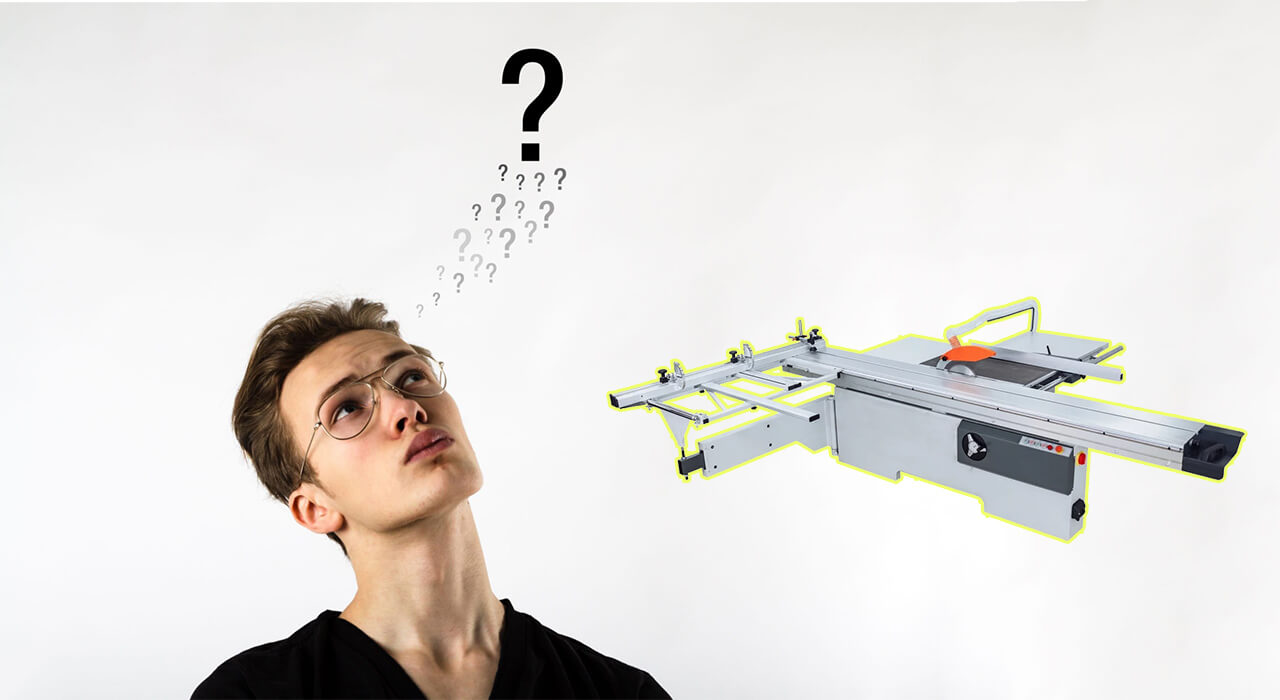
If you always cut larger workpieces precisely and safely, you will get lots of benefits from sliding table saws.
- Precision: The sliding table gives rock‑solid support for large panels, eliminating walk‑through cuts and ensuring every rip or crosscut aligns perfectly.
- Repeatability: T‑slot miter gauges and parallel guiding systems lock in at exact angles, so you can batch‑produce identical parts with minimal fuss.
- Capacity for Large Workpieces: Standard benchtop and cabinet saws typically max out at 24–30″ crosscut capacity. A sliding table easily handles panels 4′, 5′, 6′ or longer—and can even tack on extension tables for sheets over 8′.
- Safety & Ergonomics: Sliding tables keep your hands out of the blade path. You push or pull the workpiece rather than reaching over a spinning blade, reducing kickback risk. Scoring units mounted ahead of the main blade can prevent tear‑out on veneers, further cutting down on wasted material and potential blade‑binding hazards.
- Versatility: Beyond straight crosscuts and rips, you can integrate add‑ons like tenoning fixtures, featherboards, and digital readouts. Many CNC‑ready sliding saws even allow programmatic cuts directly from CAD files.
2. Why Buy Sliding Table Saw From China?
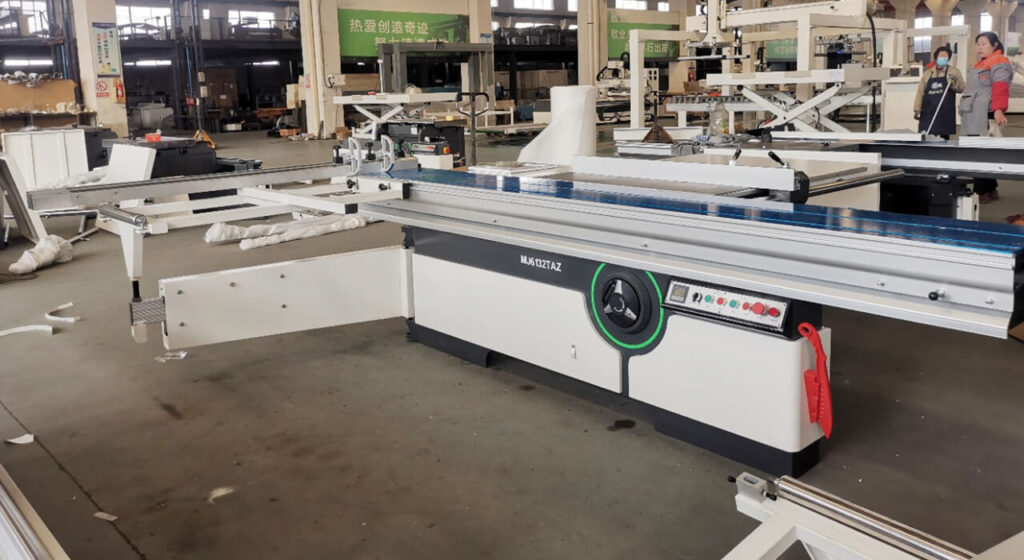
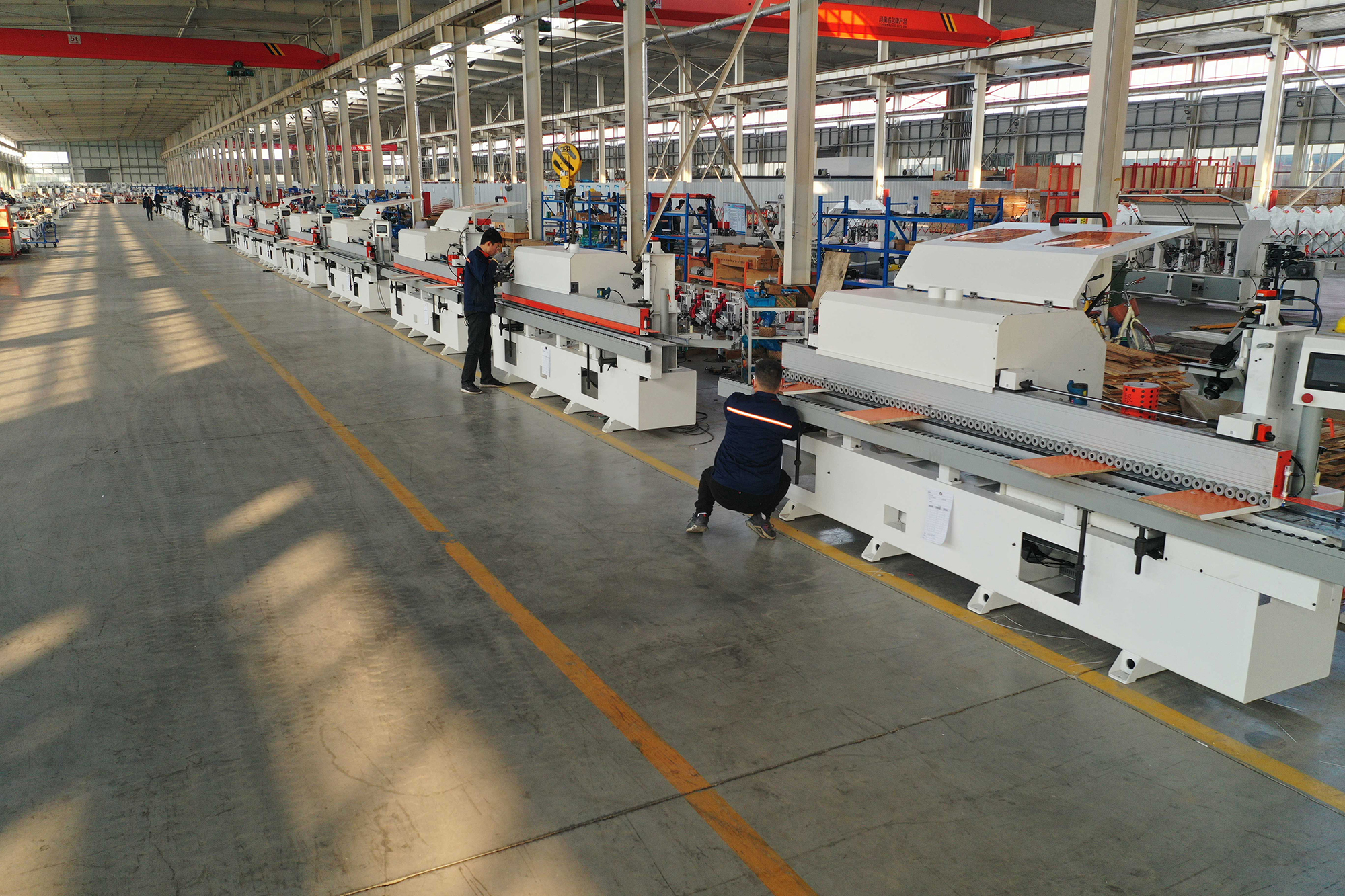
China’s dominance in Sliding Table Saw production isn’t a fluke—it’s a result of strategic manufacturing hubs and unbeatable economics. Cities like Qingdao, Shanghai, and Guangdong are buzzing with factories pumping out China sliding table saws at scale. These regions combine advanced infrastructure with a skilled workforce, keeping costs low and output high.
2.1. Cost Breakdown: Chinese vs European Saws
Here’s the reality: a China sliding table saw ranges from $2,000 to $25,000, while German or Italian equivalents start at $25,000 and can soar to $80,000. That’s a massive gap, especially for businesses scaling up.
But what about quality? While European saws boast premium branding, many Chinese manufacturers now match their specs—think crosscut capacity, scoring systems, and CE/UL certification—at a fraction of the price.
Pro Tip #1: Always cross-reference factory certifications (CE/UL) with official registries online before you pay a deposit.
2.2. Availability
China is the world’s largest manufacturer of sliding table saws, with many manufacturers producing a wide range of models to meet different needs and budgets.
2.3. Customization
Chinese manufacturers are often willing to customize their products to meet the specific needs. It coved modifications to the design, features, and even the size of the saw, making it a more tailored solution for individual users.
3. 3 Sliding Table Saw Types from China
Modern Chinese manufacturers offer machines ranging from economical manual models to fully automated CNC systems.
Understanding the different types of sliding table saws helps you choose the right machine.
3.1. Manual Sliding Table Saw
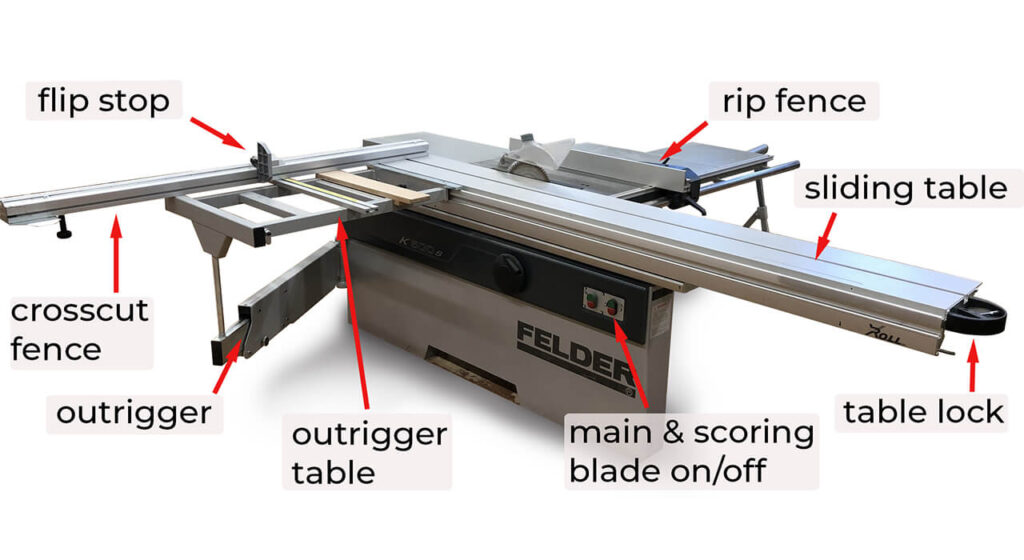
The manual sliding table saw is the most common entry-level model. Operators manually adjust blade height, blade tilt, rip fence position, and sliding carriage movement.
These machines are suitable for small workshops, custom furniture makers, and startup cabinet businesses. They provide reliable cutting performance while keeping investment costs low.
Key Features:
3.2. Automatic Sliding Table Saw
Automatic sliding table saws introduce powered functions that reduce manual adjustments.
These machines bridge the gap between conventional equipment and full CNC systems.
Key Features
3.3. CNC Sliding Table Saw
CNC sliding table saws is the highest level of automation. Operators input dimensions through a touchscreen control system, and the machine automatically positions fences and cutting components.
These systems improve productivity and reduce dependence on operator experience.
Key Features
4. Structural Comparison: Linear Guide vs. Round Bar Systems
The sliding mechanism is the absolute heart of any panel saw. Its engineering determines whether your machine delivers clean edges or frustrating panel chip-outs.
Chinese factories primarily utilize two different engineering designs for their slider beds.
Round Bar Rail System VS Linear Guide Rail System
|
Round Bar Rail System |
|
|
Solid Steel Cylinders |
Precision Ground Profile Tracks |
|
High Impact Resistance |
Multi-Point Ball Bearing Contact |
|
Easier Manual Calibration |
Superior Rigidity Under Heavy Loads |
The first design is the traditional round bar rail system. It uses solid steel cylinders paired with ball bushings to guide the aluminum table. These systems excel at absorbing heavy impact shocks from dropped timber sheets.
Furthermore, round bars are more forgiving if your workshop floor is slightly uneven. According to linear motion engineering data, round shafts allow up to half a degree of rotational self-alignment. This tolerance makes them significantly easier to adjust by hand using simple tools.
However, profile linear guides—often called square rails—are becoming the premium industrial standard. These systems feature ground steel tracks that match the exact curve of internal ball bearings. A 25mm profile square rail can handle immense loads up to 20 kilonewtons.
This multi-point contact provides incredible structural rigidity. It prevents the cutting table from deflecting when you load massive, heavy panels.
5. How To A Find Good Sliding Table Saw Supplier In China?

If you have decided to buy a sliding table saw from China, it’s extremely important to find a good supplier.
It’s not difficult as you imagined. There are some ways and guide to help you find a good sliding table saw supplier. Also if you need source service, you can contact to Sourcifychina. They can offer good service.
5.1. Online
If you’re in the market for a sliding table saw for your next woodworking project, the internet offers a wealth of resources to help you find a reputable supplier.
It is one of the simplest and most economical ways to locate a supplier that meets your specific needs.
5.1.1. Google

When searching for a sliding table saw online, Google can be a useful tool to help you find potential suppliers.
However, there are so many options available. And it’s important to take the time to research and evaluate each supplier, which can ensure the one that meets your specific needs.
To start your search, you can use specific keywords that narrow down your results, such as the type of saw you’re looking for, your budget, and any specific features you require.
This can help you create a list of potential suppliers to consider.
5.1.2. Alibaba
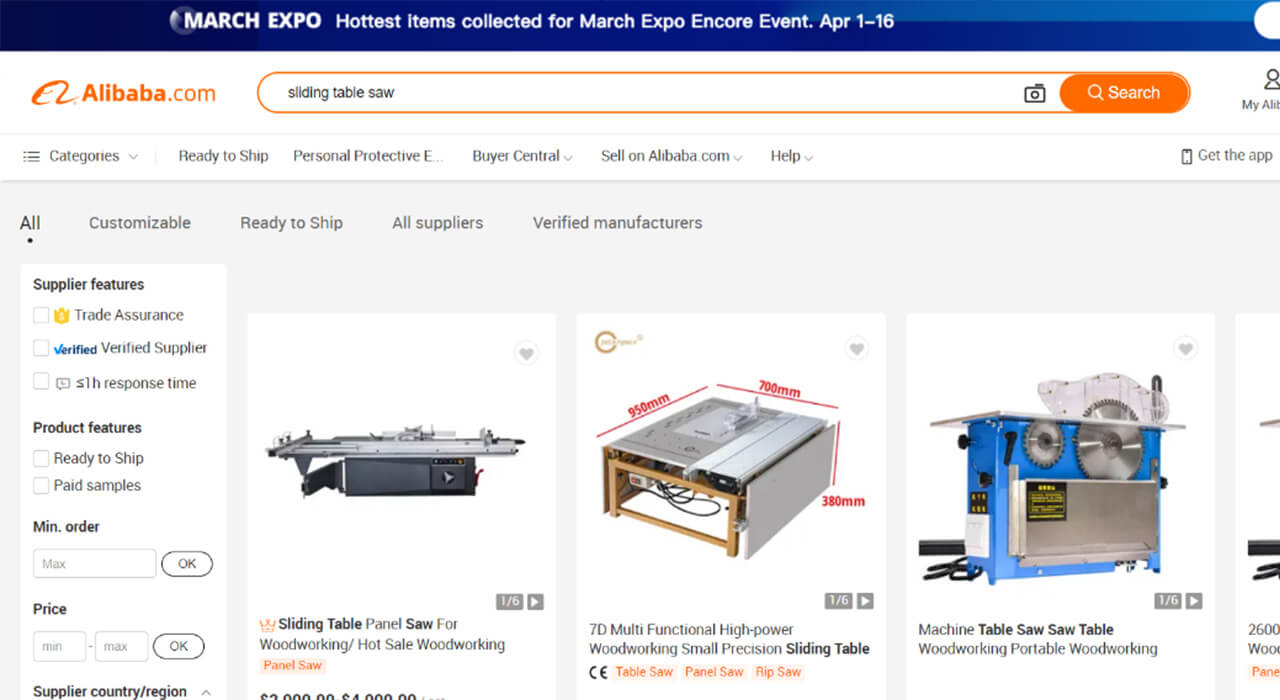
Alibaba is one of the world’s leading online marketplaces for industrial equipment.
With a vast selection of sliding table saws from top manufacturers, you’re sure to find the perfect machine to suit your needs and budget.
To begin your search, simply browse through Alibaba’s extensive inventory of sliding table saws.
You can narrow down your options by brand, price range, blade size, and other important criteria.
Take the time to carefully read product descriptions and pay attention to cutting capacity, motor power, and safety features.
5.2. Find Sliding Table Saw Suppliers By Visiting China

Visiting factories in person can be a great way to connect with potential suppliers of sliding table saws.
You can research potential factories to ensure that they specialize in producing sliding table saws before visiting.
During your visit, be sure to inspect the factory’s facilities and equipment to ensure that they meet your quality and safety standards. Ask questions about the manufacturing process and any quality control measures that are in place.
Consider visiting multiple factories in the same region to save time and minimize travel expenses.
Qingdao is a well-known hub for woodworking machine manufacturers. It makes it an ideal destination for anyone looking to source a sliding table saw from China.
With so many manufacturers in one place, it’s easy to compare products and prices to find the best fit for your needs.
Additionally, many Qingdao-based manufacturers have extensive experience in exporting their products, making the process of working with them smoother and more streamlined.
5.3. Exhibitions

Attending major exhibitions—LIGNA (Germany), Xylexpo (Italy), CIFM (China)—offers direct interaction with manufacturer representatives. For Chinese shows, CIFM in Guanzhou is a hotspot: you can inspect machine build quality, watch live demos, and negotiate face-to-face.
6. Certification And Testing Of Sliding Table Saw
6.1. CE Certification for the EU Market
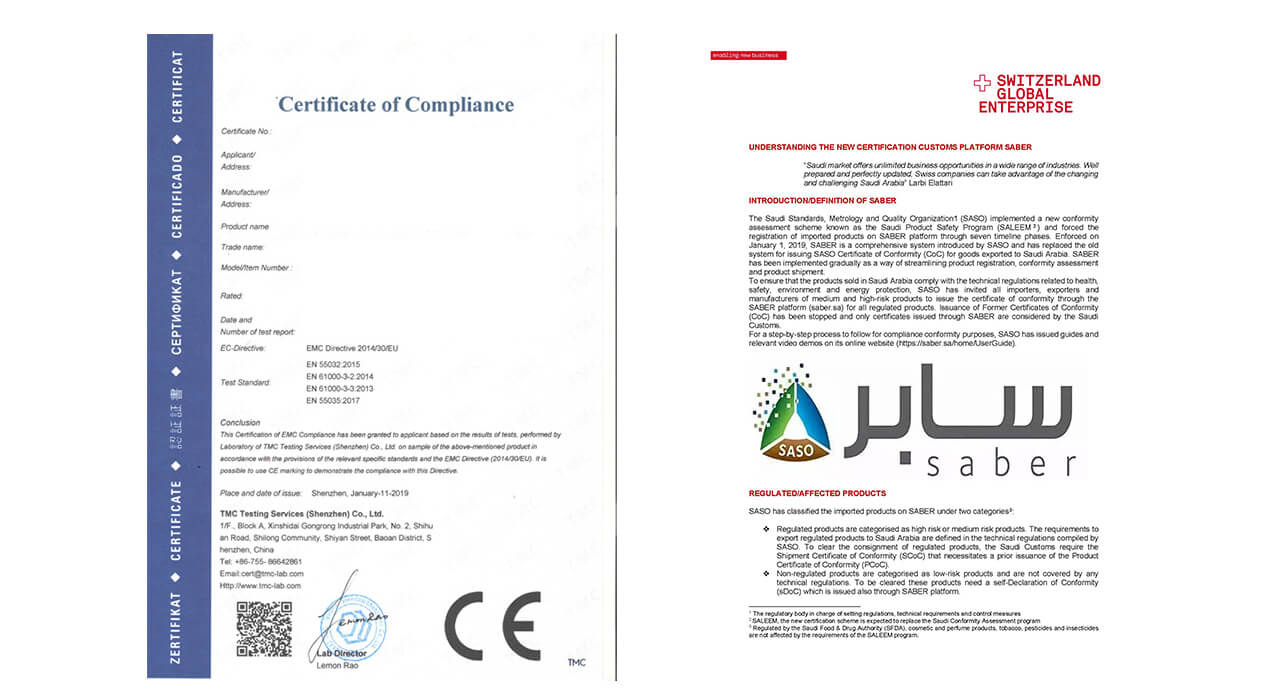
Sliding table saws destined for European customers must comply with Machinery Directive 2006/42/EC. CE marking indicates conformity to essential health, safety, and environmental requirements.
-
Check the Declaration of Conformity (DoC): Should list relevant EN ISO standards (e.g., EN 1870-1).
-
Inspect the Test Reports: Type-test reports from accredited labs (e.g., TUV Rheinland) validate safety guards, electrical wiring, and blade guard interlock systems.
6.2. Other Regional Standards
In addition to being a quality recognition, the certification can also serve as a required document for customs clearance in some countries.
For Example:
If you’re importing a sliding table saw to Saudi Arabia, you must obtain a Saber certificate for customs clearance. This certificate is mandatory and needs to be presented to customs officials for the product to be cleared.
Additional:
- North America: UL or CSA certifications may be needed for electrical safety.
- Australia/New Zealand: SAA approvals can smooth import clearance.
- Latin America: INMETRO (Brazil) or NOM (Mexico) certifications.
Therefore, it’s crucial to ask your supplier for a copy of the certification certificate. It can avoid any issues during customs clearance.
7. What Is Sliding Table Saw HS Code
When you buy sliding table saw from China or other countries, it is important to learn sliding table saw hs code.
The Harmonized (Commodity Description and Coding) System or HS code is a classification system using a six-digit number to identify each merchandise unit. Customs use this number to classify products.
The structure of the HS code is as follows:
- The first two digits represent the Chapter.
- The second two digits represent the Heading.
- The last two digits represent the Subheading.
So what is sliding table saw hs code?
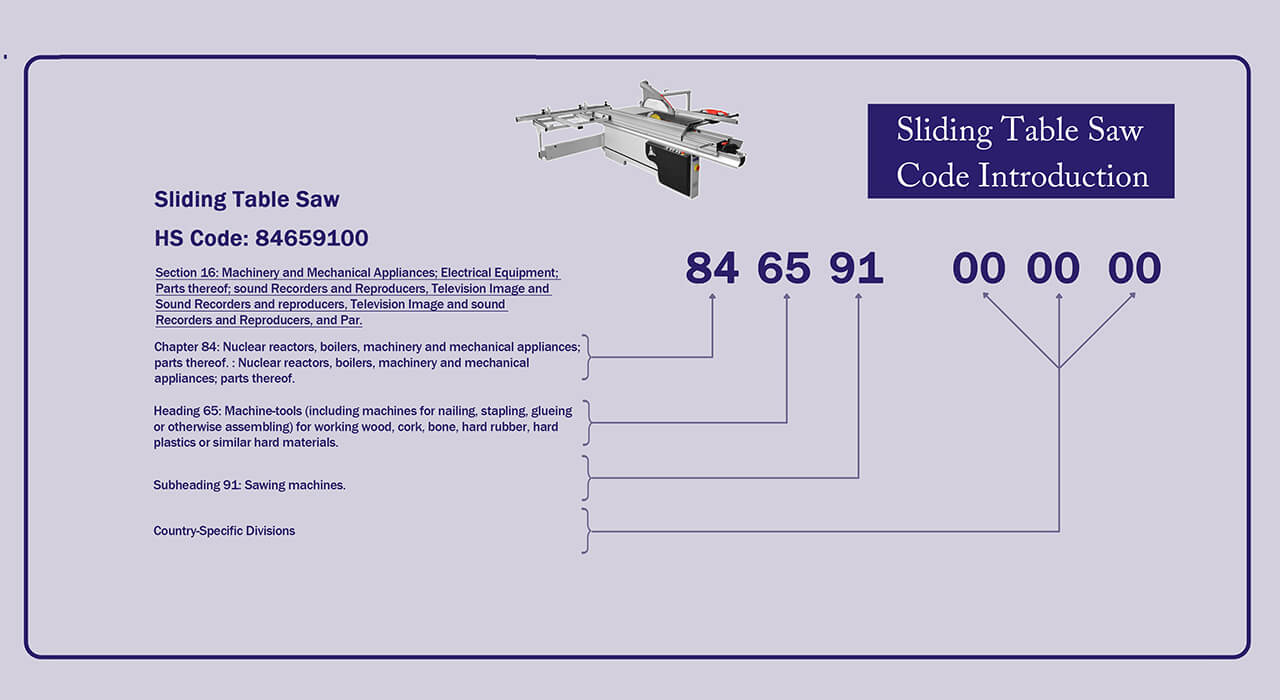
Sliding Table Saw HS Code Is 84659100.
8. Requesting Quotes and Price Negotiation
8.1. Preparing a Detailed RFQ
Your Request for Quotation (RFQ) should include:
- Model numbers and specifications you’re comparing
- Quantities (single unit vs. batch orders)
- Desired certifications and optional add-ons (scoring saw, tilting table)
- Packing requirements (wooden crate, fumigation)
- Delivery port (e.g., FOB Shanghai, CIF Houston)
8.2. Price Components
- Unit cost of the machine
- Add-on accessories (scoring units, laser guides)
- Packaging and inland transport to port
- Customs documentation fees
8.3. Negotiation Strategies
- Leverage volume: Commit to multiple units or a long-term partnership for better rates.
- Bundle accessories: Negotiate a discounted package for blades, fences, and spare parts kits.
- Ask for extended warranty or free installation as value-adds.
Always get quotes in writing, with validity dates and clear payment milestones.
9. Quality Control Strategies
9.1. Pre-Shipment Inspection Checklist:
- Table flatness: max deviation 0.05 mm.
- Runout tolerance: < 0.1 mm at blade arbor.
- Guiding system play: < 0.2 mm side clearance.
- Motor noise levels: < 85 dB at 1 m.
- Electrical wiring: UL/CE-grade cables, correct grounding.
9.2. Testing Protocols
- Vibration analysis at 3,000 RPM.
- Cut test on MDF and hardwood at max feed rate.
9.3. Third-Party QC Services
SGS, QIMA, Bureau Veritas offer competitive rates for machinery inspections—budget around $400–$600 per inspection.
10. Logistics &Shipping
10.1. Packaging and Crating
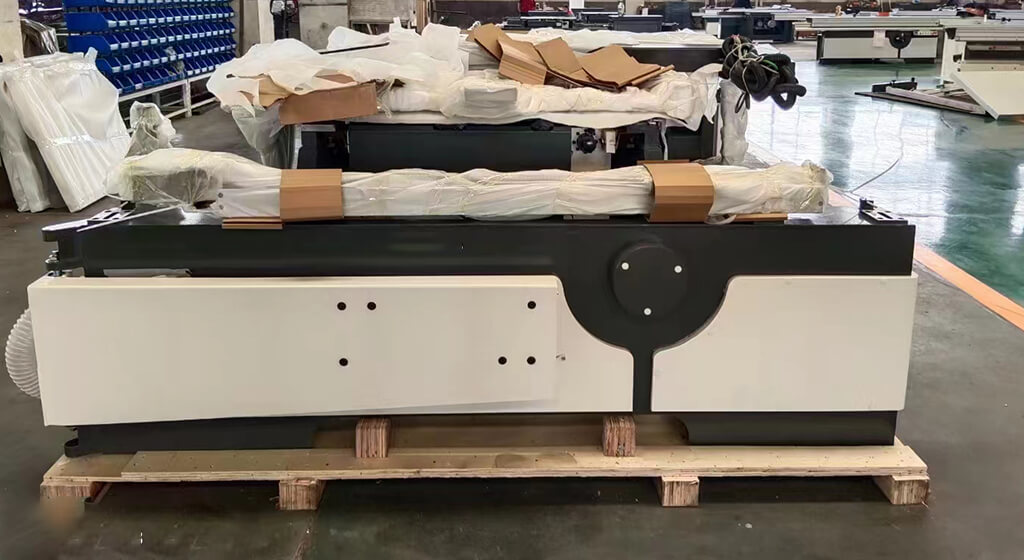
Sliding table saws are heavy, precision equipment:
- Anti-rust film on exposed metal
- Shock-proof foam inside crates
- Fumigated plywood crates to comply with ISPM-15
10.2. Shipping Cost
When you import a sliding table saw from China, it’s crucial to consider the shipping cost.
It can vary depending on factors such as the country of destination and the chosen shipping method. The most affordable option is usually shipping by sea.
For Instance, let’s take the case of one of my clients who purchased a sliding table saw.
“Mr. Smith is a skilled woodworker based in the US who creates bespoke cabinetry for local clients. When he wanted to buy a high-end sliding table saw STS32H from us, we happily supplied the product.
To minimize shipping costs, we opted for sea shipping, which turned out to be the most economical choice. Although the shipping fee from Qingdao port to Orlando port was advertised as zero dollars, we still ended up paying over $400 to the freight forwarding company.
Why? Well, it’s important to note that the zero-dollar rate only applies to the shipping cost. We still had to pay for the freight forwarder’s labor and the destination port.”
It’s not uncommon for suppliers to offer zero shipping costs while excluding other charges.
Therefore, it’s essential to clarify the total cost of shipping, including any charges related to the destination port, when requesting a freight rate.
By doing so, you can avoid unexpected expenses and ensure that you’re getting the best deal possible.
10.3. Customs Document Checklist
- Commercial Invoice.
- Packing List.
- Bill of Lading.
- Certificate of Origin.
- CE/UL Certification.
Pro Tip: Use HS Code 8465.99 for woodworking machinery to avoid delays. Misclassification can stall your shipment for weeks.
Pro Tip: Hire a customs broker familiar with 2024 Chinese export regulations—they’ll save you headaches.
11. Precision Calibration: The 5-Cut Method for Perfect Squares
A sliding table saw is only useful if it cuts perfectly square panels. When a machine arrives from an overseas factory, the rough ocean transit often jars the alignments out of specification.
Buyers must perform a thorough manual calibration sequence before running production.
Step 1: Level the Main Cast-Iron Bed
Requires Precision Level.
Place a machinist level accurate to 0.025mm per 300mm across the cast-iron table. Adjust the machine’s leveling feet until the bubble stays perfectly centered in both directions.
Step 2: Align Sliding Table Height
Set Table Offset.
Adjust the sliding table support rails until the aluminum slider sits exactly 0.10mm higher than the cast-iron table. This slight elevation prevents heavy veneer sheets from dragging and scratching.
Step 3: Parallel the Main Saw Blade
Use Dial Indicator.
Mount a dial indicator to the sliding table carriage. Slide the indicator along the body of the blade to ensure the slider moves perfectly parallel to the blade face.
Step 4: Set Crosscut Fence Angle
Execute 5-Cut Method.
Clamp a large square panel to the crosscut fence. Make four sequential rotating cuts, then cut a final thin strip. Measure the strip with digital calipers to calculate exact angular error.
The mathematical formula for the 5-cut method distributes any hidden angular error across four separate joints. This amplifies the physical deviation by a factor of four, making it easy to identify.

Fine furniture makers target an accuracy tolerance of 0.10mm over a full 2,000mm crosscut. If your digital calipers show a difference between the front and back of your fifth cut, you must adjust the fence’s flip stops.
Take your time during this step; micro-adjusting the fence positioning pin is a tedious process. Skimping on calibration guarantees gaps in your cabinet carcase joinery later on.
12. Now, You Can Get Started!
A sliding table saw is one of the most valuable investments for professional woodworking operations. It improves accuracy, increases productivity, enhances safety, and supports consistent quality.
Whether you operate a cabinet shop, furniture factory, or custom woodworking business, selecting the right machine can transform production efficiency.
Focus on workflow requirements rather than purchase price alone. You should consider table length, motor power, scoring capability, support services, and future expansion plans.
When chosen carefully, a quality sliding table saw can deliver reliable performance and strong returns for many years.